Trying To Face ‘Agnosia’!
Posted on: Feb 28, 2013
 twitter
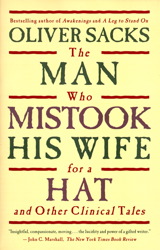
Brain is mysterious organ. It is the mastermind of all your daily activities. More you know about brain, more you will get tangled! Many researchers have spent their whole life trying to understand little but still this object is cryptic. Oliver Sacks is one of those researchers. He studied many neurological cases where classical neurology faces radicle challenges to explain them. He says his whole life is with sick and that sickness drives him to think what he could not have thought without it. His most popular book “The Man Who Mistook His Wife for a Hat and Other Clinical Tales” published by ‘Simon & Schuster’ in 1985 in which he has described some case studies of his patients. This book got critically acclaimed and was economically successful. Many other websites and blogs have already spread across internet dissecting these cases. Most fascinating study I came across in this book is the story of Dr. P. This is the story of Visual Agnosia patient who is not able to recognize faces. Not even his Wife’s face, which he thought is Hat!
 Dr. P, proficient musician as well as painter, was having some problem with his vision. After some tests his ophthalmologist thought problem is with brain and suggested him to visit Dr. Oliver Sacks who was neurologist. He indeed was right. Dr. Sacks found out in few tests that Dr. P is not able to recognize familiar human faces. He was clearly the victim of visual agnosia and more precisely ‘prosopagnosia’ which is disorder of face perception where face recognition is impaired but rest of visual process and intellectual functioning is normal. His conversations with Dr. Sacks obviously suggest that he is fluent with his conversation which may indicate that he is fine with his verbal and communication areas in brain. In some tests where Dr. Sacks asked him to recognize hand gloves, he was unable to identify them. This is hinting towards more complex agnosia. He asked Dr. Sacks to give him hand gloves so that he can ‘feel’ it. I guess he was not getting enough visual information (Which is questioned in postscript by Dr. Sacks) this involving some Apperceptive visual agnosia, where victim cannot form a whole percept of visual information. But event where he was analyzing National Geographic Magazine refutes our assumption about apperceptive visual agnosia. Where he was able to recognize tiny details quite well but again he was unable to perceive that picture as a ‘whole’. We can infer from this is that this was not the only prosopagnosia case but combination of more. Another striking feather about this disorder was Dr. P was able to perform all his routine functions with music and singing. That incidence on the dinner table, when he suddenly goes into shock, there was someone at door (or when someone interrupted his singing) implies that he associates most of his actions with his ears. This is also hinted when Dr. Sacks described his first meeting as “He faced me with his ears”. Dr. Sack’s inference about the paintings is somewhat confusing. He has no idea about the mentality of Dr. P. Was he trying abstract art or it was just outcome of his malfunction? May be or maybe not. If this was artifact of his vision processing, this could be the more evidence that he was able to perceive visual information but was not able to understand it as a whole. When we look at these conditions Dr. Sack’s description about Dr. P as a mere computer sounds logical. He can receive all normal information which others are receiving but is not able to process it normally. Emotional, cognitive component in this case is very subtle. Even Dr. Sacks was very careful when he brought up that point in the postscript of this case study.
In conclusion, I think, our knowledge of how brain functions is limited. Classical neurobiology is not sufficient to answer all the questions we are facing. The curious cases like Dr. P’s agnosia are important in understanding some new concepts. Finally Dr. P’s case was not just the simple prosopagnosia but the blending of some other disorders. Yet elusive fields in this area like emotions, cognition, judgment etc. are subtly involved in these studies. The concepts like ‘Abstract Attitude’ need to be modified. But in the end understanding of cases like Dr. P’s agnosia is keeping us one step closer to understanding this very complex structure!
— Rohit [DeXteR] Suratekar
Image Courtesy: Wikimedia Commons
[ http://en.wikipedia.org/wiki/File:The_Man_Who_Mistook_His_Wife_for_a_Hat_cover.jpg%5D [Accessed on 28 February 2013]
References
- Oliver Sacks. The Man Who Mistook his Wife for a Hat and Other Clinical Tales. Simon & Schuster (1985)
- The Case of Dr.P & Visual Agnosia. Web Link: http://webfusion.net.nz/oliver_sacks_dr.p.html [Accessed on 28 February 2013]
- Wikipedia. Visual agnosia. Web Link: http://en.wikipedia.org/wiki/Visual_agnosia [ Accessed on 28 February 2013 ]
- Wikipedia. Prosopagnosia. Web Link: http://en.wikipedia.org/wiki/Prosopagnosia [ Accessed on 28 February 2013 ]
Original Post: https://rohitsuratekar.wordpress.com/2013/02/28/trying-to-face-agnosia/